
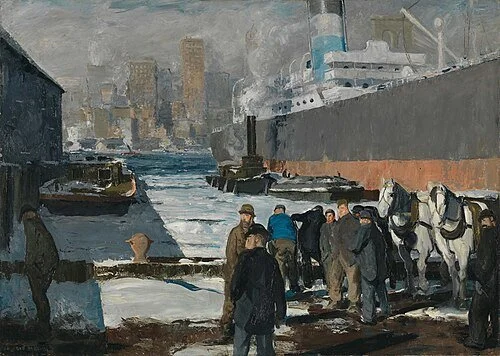
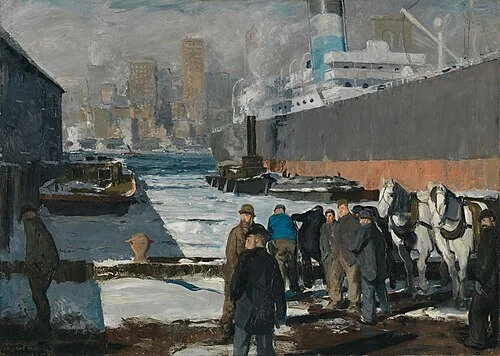
George Bellows, Men of the Docks, 1912. oil on canvas, 114.3 × 161.3 cm. The National Gallery, London.
‘Men of the Docks’ is an oil on canvas painting in the National Gallery, London. This compositional riverscape encapsulates an ephemeral moment that arguably mirrors the institutional awkwardness of an art gallery ‘trying to reposition itself’. Much like the institutional narrative that espouses du jour global expansionism and the embrace of the ‘other’, this work exposes the societal readiness of an American culture that propagated filthy urban slums and ‘opened its shores to immigrants yet sought to deny its European roots’. Deservedly, the ambivalent irony is perhaps not lost, that this painting, the first major American work since the gallery opened in 1824, now occupies its rightful place amongst French Impressionism, this ‘comme il faut’ homecoming, made only recently possible given the gallery’s decision to ‘expand’ its curbed mandate from European paintings to include those ‘works in the European tradition’. Geography is the emotional narrative that has tied this painting to a squalid New York dockside. This landscape composition cares not that the early morning winter sun has little effect on the biting cold that has rendered the East River a frozen solid mass of misery. In the foreground an unpleasant edge of heavy impasto brown sludge is the only indication of where the river ends, while a dockside bollard is rendered superfluous; it waits, as do the men gathered in a huddle of the disadvantaged.
Captured amidst this guttural urban maelstrom, immigrant casual labourers wait in the hope of work, their foreman stands front and centre, but for you, the viewer, he offers nothing but his back, unlike the seven or so men who will be picked up in exchange for sweat and toil, and for today at least they will have shunned uncertainty. Beneath their battered hats and heavy coats there is little respite from frozen hands buried deep into pockets, the dirge of muted colour blurs into a solid block of form still recognisable as those on the margins of society.
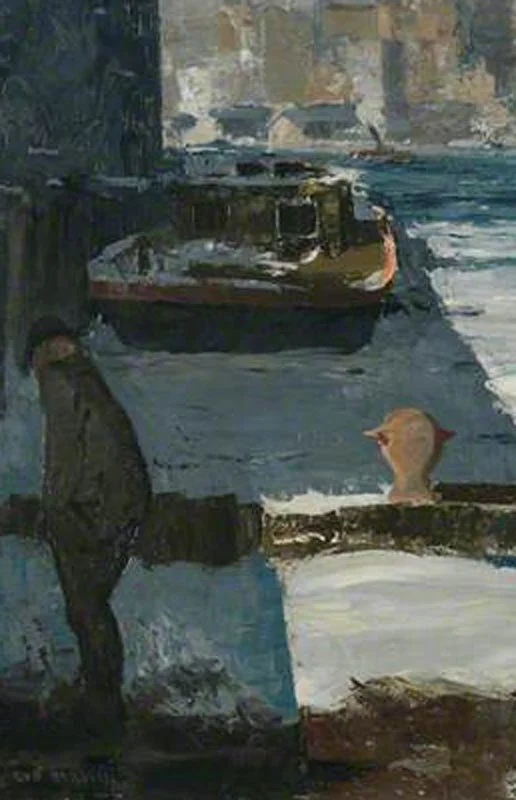
Detail: A dejected dockworker walks beyond the picture space unable to find work today.
There is a sense of the voyeur as we acknowledge the rejected figure walking away, the collective ‘gaze’ of the men stood watching diverts our attention to his plight, and for the briefest of moments we become part of the reprieved. Beyond the shoreline the severity continues as this open composition bleeds into every edge and crevice challenging the spectator to visualise a life outside the picture space. The ship’s bow and warehouse are cruelly cropped while forming the visual cues of linear perspective, and in the distance our ‘eye’ is taken across the river, to the newly built skyscrapers of Lower Manhattan, a felicitous metaphor of the brutal societal inequalities that have juxtaposed the horse(s) and cart in the foreground with a post-industrial modernity.
Progress, nonetheless, is intent on belching out its guttural arrival, as the foreshortened blackened tug manoeuvres a barge alongside the ship’s vertical hull, its muted rouge plimsoll line serves as the perfect atmosphere against which the silhouettes of several minuscule characters can be seen working toward the vessel’s stern and, perhaps by default, they reinforce ‘the brevity and fragility of human life’, through the technique of scale and proportion.
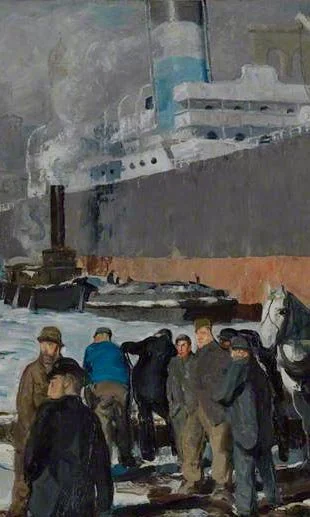
Detail: figure in Blue, a feature present in Paul Cézanne’s (1839-1906) Bathers (Les Grandes Baigneuses).
The artist George Bellows never left the United States of America, born in Columbus, Ohio, he would move the short distance to study at the New York School of Art under the tutelage of Robert Henri (1865-1929) amongst others, becoming a member of the ‘Eight’ and the ‘Ashcan School’, a likeminded unkempt assemblage that had found a ‘stark visual language’ that Bellows himself described as ‘the harsh poetry of the slums’. While much of Bellows’ work has remained a largely parochial thematic study of urban humanitarian decay, ‘Men of the Docks’ be it posthumously, has taken the metaphoric globalisation route, placing this work beyond the reach of the here and now, which ‘emancipates him from U.S. museum displays’, and, in doing so, has arguably ensured, ‘the local is the past and the global is the new’. If this be the case, then perhaps the ambiguous if not ‘convenient’ arguments that an artistic location did somehow subvert opportunity, be that creative or otherwise, is more than a little difficult to accept.
Bellows worked on the streets of New York when ‘plein air subjects were still a novelty’, it was artistic integrity and his ability to ‘bridge the chasm of conservative and radical art’ that had carried both weight and purchase, not least the subtle use of light and chiaroscuro within the dramatic areas of opposing shade. Saturated and blended colour with translucent hues add drama if not an underlying sense of anxiety which can be seen in the rapid, almost apathetic disregard for brushstrokes applied with an anarchic mindset, he cared not about the populist whims of institutions, Bellows personified the American spirit, his aim was ‘to capture real life as he saw it’.
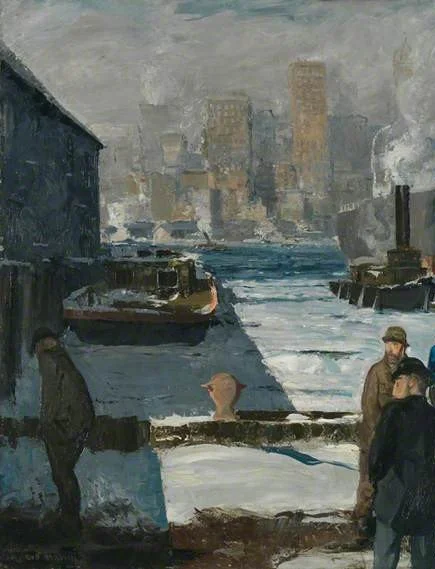
Detail: in the distance, across the river the newly built skyscrapers of Lower Manhattan.
A ship from Liverpool, England, in the livery colours of the Lamport and Holt Line, lay abut her dockside berth.
It is perhaps not by coincidence, that Bellows’ style was likely influenced; consider for example how little regard he shows to facial expression as seen in this work, the use of ellipse and elongation the likes of which were popularised by Amedeo Modigliani (1884-1920) who was both active and exhibiting at this time. Or the undeniable features that are present in Paul Cézanne’s (1839-1906) Bathers (Les Grandes Baigneuses), with the richest use of earthy tones and cobalt blues as seen in the dock worker’s jumper who stands out as an obvious comparison. There are many similarities not least the strong diagonal lines, the use of structural grouping, characters with their backs turned to the viewer and so much more. It is perhaps no surprise then, that these works have been sited à côté de, in The National Gallery and, for many, hugely significant ‘to see Bellows in a European context’, and this achievement must duly be acknowledged as an example of institutional harmonisation.
While it is poignant to realise, this work, unlike the artist, successfully crossed the Atlantic Ocean, it would take in excess of a hundred years, and a meaningful realignment with curatorial policy before this work was secured. It is not therefore perhaps unreasonable to suggest the historic institutional mandate belied past opportunities to acquire works created beyond those produced within a Western European Canon. Museums and Galleries are our natural link to the past, and therefore as such, what and how works or artefacts are collected and displayed determine our cultural reach and, in doing so, can be seen to emulate the same aspirational desires and entanglement of the studiolo. In the act of ‘gathering up possessions in arbitrary systems of value and meaning’ it is arguably a reflection of ancestral enlightenment, nonetheless, it exposes the whole process to the inevitable tension that accompanies the ‘global’, and as such ofttimes materialises through inherent ‘historical patterns of power and privilege’.
It has been suggested art history ‘has always had a very active geographic imagination’ however, while this may be true, it is of little value if not developed into something more meaningful and a proactive inclusive representation, and as such, be prepared to move beyond the abstract of populism or any other historical ideology irrespective of insular self-inflicted limitations.
George Bellows captured the antithesis of a biting cold New York bathed in the early morning sunshine, in many ways it was a chronological affidavit for the impoverished, yes, told through the chaotic optimism of a fledgling nation, but nonetheless one unable to hide the inevitable societal bruising. On pier 6/7, abeam the Brooklyn Bridge, a ship from Liverpool, England, in the livery colours of the Lamport and Holt Line, lay abut her dockside berth, the embodiment perhaps of a new transatlantic ‘global’ world, and one this work by Bellows, over time, itself would follow.
While ‘Men of the Docks’ had depicted the expansive free market capitalist economy unfolding across the East River, a similar economic reality would much later facilitate the acquisition of the painting, be it under somewhat different circumstances. It is worthwhile reiterating the painting had originally been acquired by the Randolph-Macon College, Virginia, in 1920 for the princely sum of $2,500 and permanently exhibited at the Maier Museum of Art.
As can be seen, the work was displayed in a somewhat parochial environment which by definition would have restricted to some degree who and under what circumstances the painting could and was viewed. It is perhaps this ‘limitation’ that arguably, would have affected the viewer’s ‘casual impact’, particularly as Bellows was a local artist and was possibly viewed through that contextual lens. Given the New York narrative, it could be argued the institution belied the much broader exposé, not least in the numeric and diversity of attendees, but also the chance to have the work shown even temporarily, in its authentic birthplace amongst its ‘palpable’ cultural narrative, while at the same time enjoying a ‘global’ international appreciation.
Notwithstanding the above, and the obvious hierarchy of value, place, and power dynamic that is ever present in the institutional cachet a work is housed within, or the argument of ‘contemporaneity’, that exists irrespective of geographical location through ‘interconnected market forces’, and ephemeral ‘art audiences’. Whatever the received convention, all institutions have arguably one primary obligation which, above all else, should acquiesce to the many other considerations; ‘let the work of art speak directly to you with a minimum of interference or distraction’, and it is this prerequisite that we shall now discuss in the context of a major international artistic destination. When in 2007 the painting was identified together with three other works for sale, it would not be without resistance, indeed two legal challenges were made in Virginia courts by The Association of Art Museum Directors (AAMD) to thwart any such proposed transaction, neither of which were upheld and ‘Men of the Docks’ was sold to The National Gallery, London, for £15.6 million. This was purely a fiscal reality, and one that while partly solving the short-term financial quagmire of the college, did little to nothing for the likes of the alumnae, students and the loyal residents of Lynchburg, VA.
This painting was created in New York at a time when economic immigration was at its height, and societal diaspora was for many the scourge of Western liberal societies. The painting depicts the incipient internationalism that had little regard for the have-nots, and highlights by way of juxtaposition, many contradictory realities the likes of which became a model for urbanisation ‘immigration, vast fortunes and aching poverty’. The Institutions can be seen as a help and hindrance in the geographical context, not least by limiting the artistic exposure of works by way of parochial constraint which was only satisfied having sold the work for fiscal restitution.
Equally, The National Gallery for two hundred years operated with a biased European- only mandate that, by any modern standard, should have been addressed far sooner, and as such was a hugely regrettable hindrance to the ideal of an expansive institution. George Bellows however, ‘paid no heed to what was lucrative or fashionable; sought no distinguished patrons; adopted no clichés; and flew with singular persistency in the face of public taste’. He painted on his own terms and ‘Men of the Docks’ is now a public record of that fact, and a pictorial testament of New York and its working class and, by default, modern America.
JamesWritten by James Darcy · galleriedesart.com · © 2026