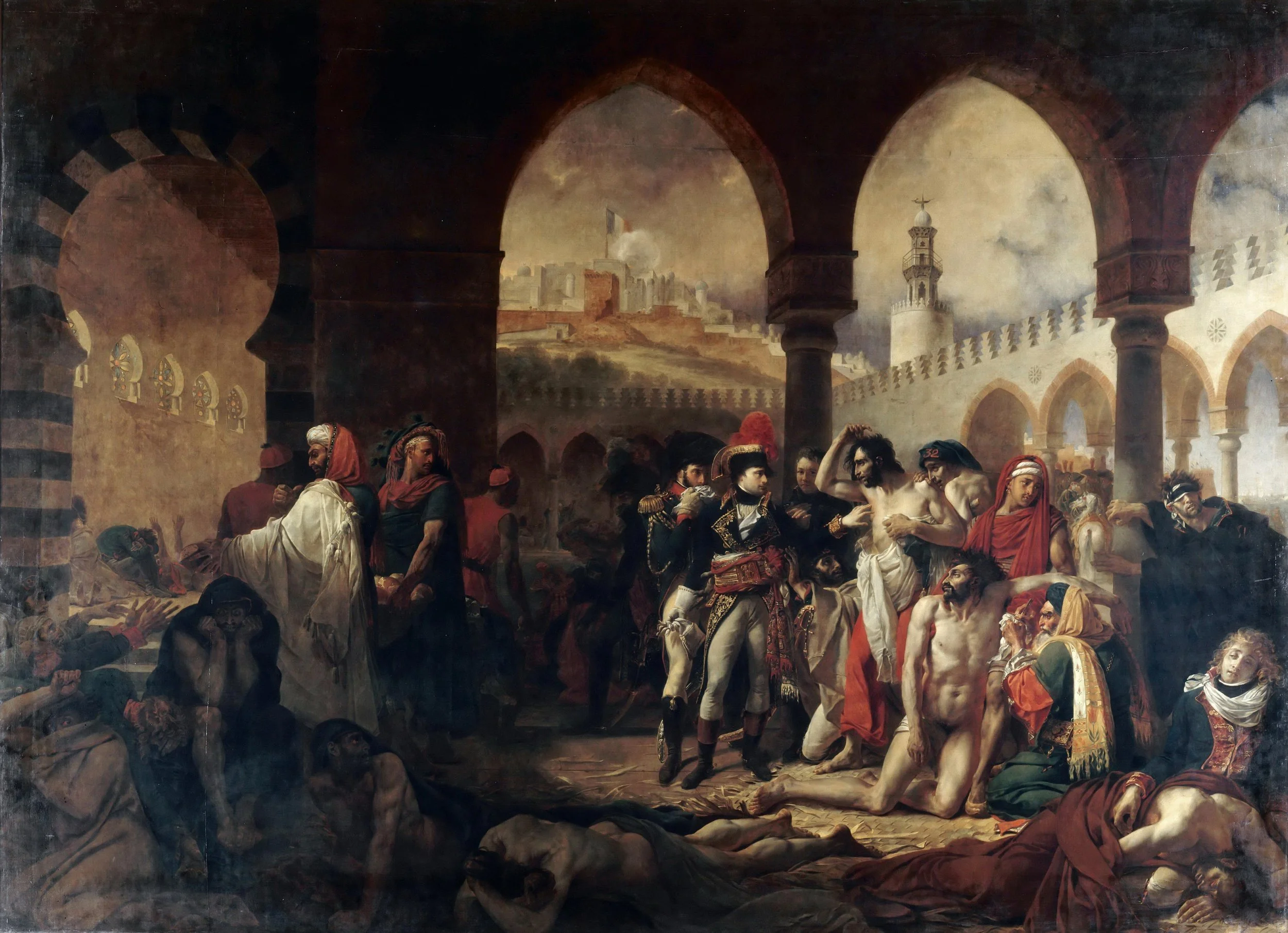
Antoine-Jean Gros, Bonaparte Visiting the Plague Victims of Jaffa, 1804. Oil on canvas, 523 × 715 cm. Musée du Louvre, Paris.
Immortalized beneath symbolic pointed arches, not as would be perceived of an Islamic mosque, but that of Saint Nicholas Monastery, Jaffa - part of the Ottoman empire, and an orthodox Christian Apostolic Church. Here lies the mise-en-scène of an eighteenth-century terrifying necrosis that settled into a civilization long before its architecture actually crumbled; a systemic fading of light that we mistake for twilight, when it is, nothing less than the dawn of our decline.
Here before you stands the masterpiece that is ‘Bonaparte Visiting the Plague Victims of Jaffa’, (1804), an oil on canvas painting by Antoine-Jean Gros, that, by its very presence, if not its intimidating scale was and remains an apotropaic historical painting, that like most, would determine whose ‘history’ could be recorded and from which artistic brushstrokes would fall beneath the ‘supervisory’ eye of Napoléon’s director of art Baron Dominique Vivant Denon.
In the filth and squalor of what was the ‘Syrian campaign’ the scene epitomises the precursor of French Romanticism, while depicting the visitation of Bonaparte to dying soldiers struck down by the bubonic plague, les pestiférés de Jaffa, an historic event during which the sacking of the fortified city had taken place, the year is seventeen hundred and ninety-nine.
Through the Egyptian horseshoe arch, in the distance the breached city walls from which the French le drapeau tricolore, can be seen unfurled, an aggressive symbol of the French revolution and newly formed republic. Stood beneath the monasteries imposing stone architecture there is a sense of darkened compression, the oriental signature duly registered by the minaret rising above the Islamic parapet, reinforcing the iconographic symbolism of an Emperor as with God, who cannot be touched by death.
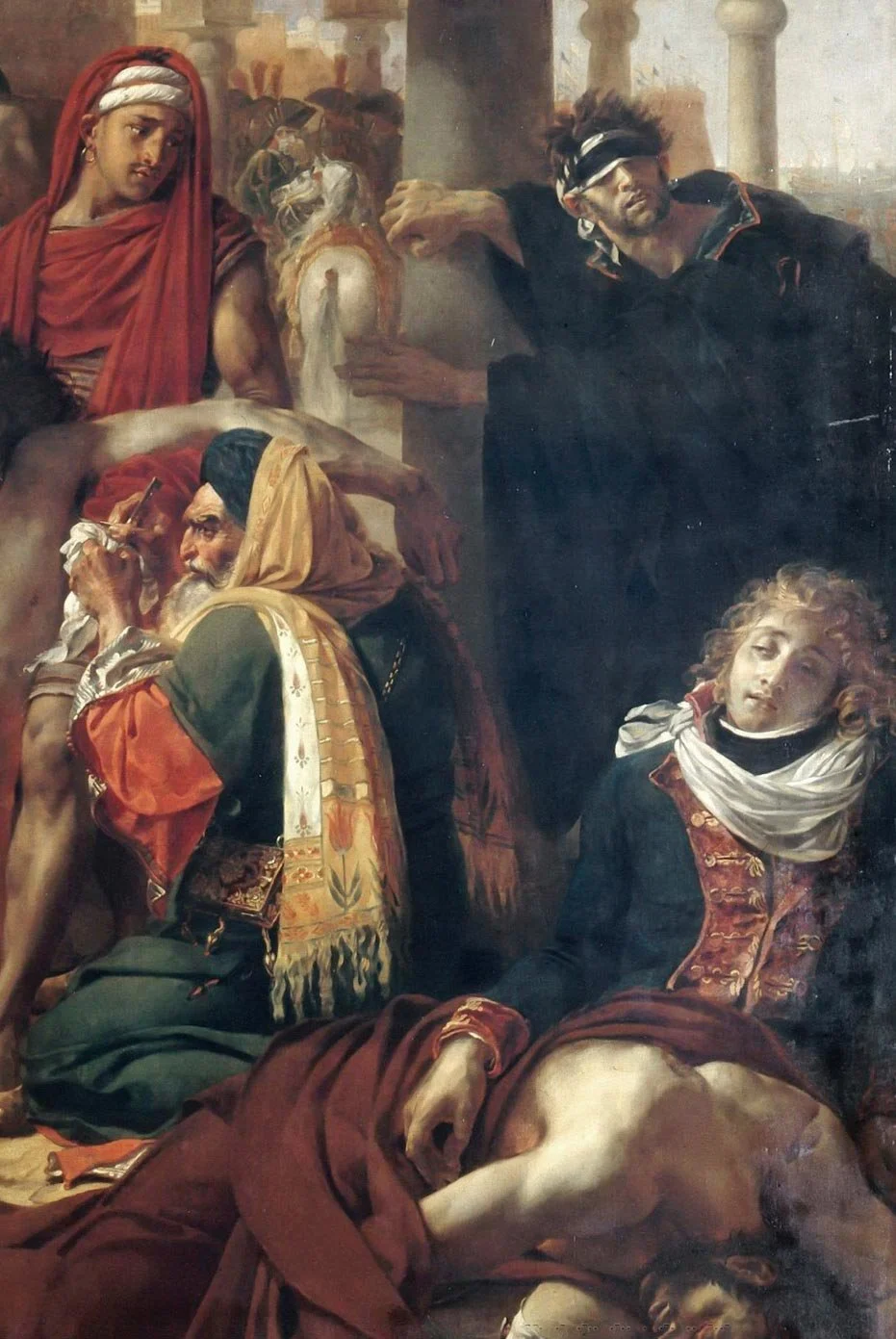
Detail: a dying French soldier in the lower right foreground, beneath a body draped in burgundy cloth.
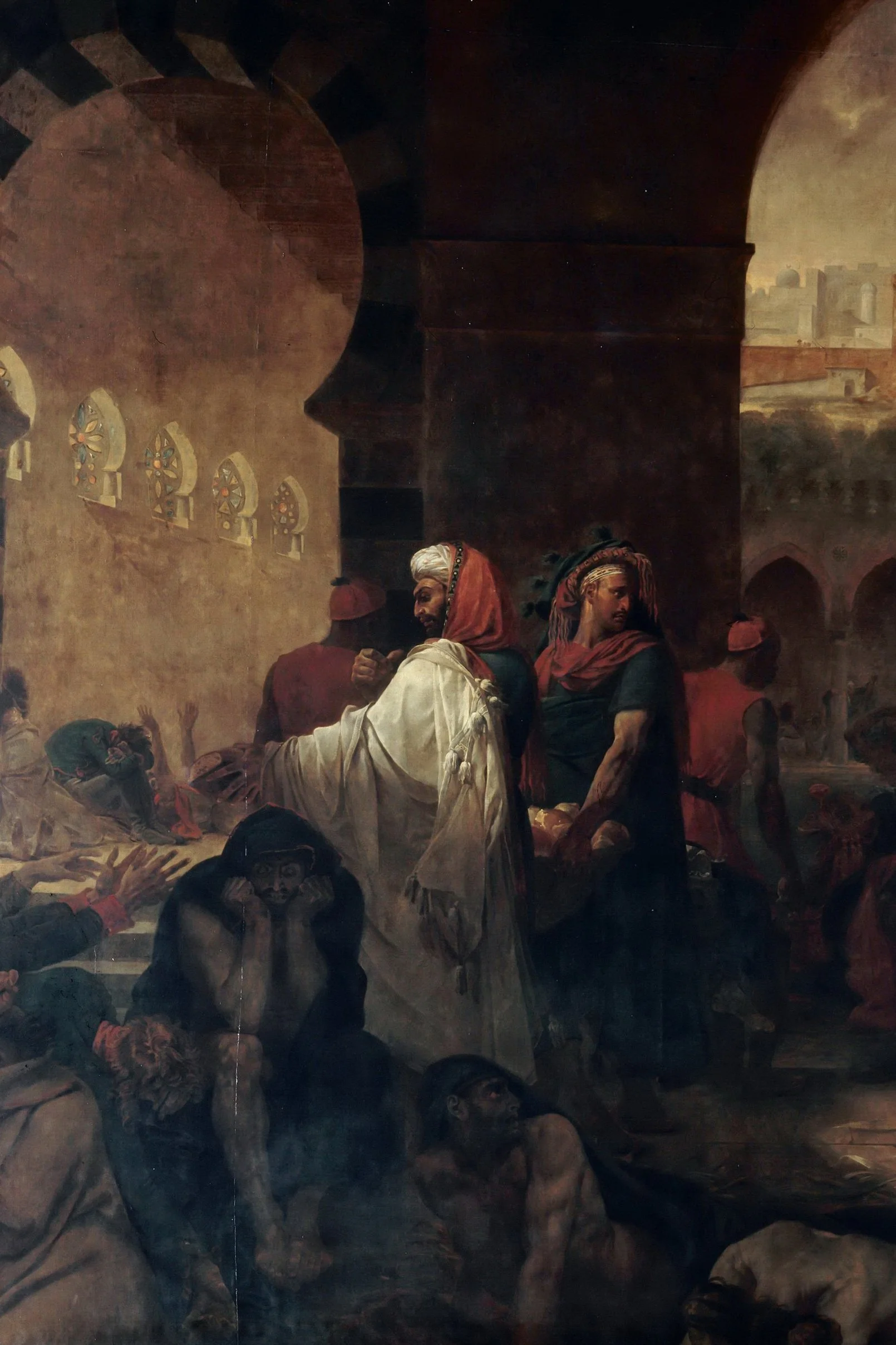
Detail: the horseshoe arch, with figures in Ottoman dress distributing bread to the sick.
In the foreground the dead and dying lie strewn across the floor, in the lower right corner a French soldier, his pallid weak complexion, with eyes closed he quietly waits, death will come for him, and soon, as with the corpse slumped across him, wrapped in a swath of flowing burgundy vesture, a classical submission to an ancient past reimagined through an act of historic idealised propaganda.
To the left, a futile gesture as an oriental figure, holds out a basket of bread, while a cadaver is stretchered away behind him, and there, front and centre, stands the majestic Napoléon Bonaparte, untouchable, amidst the stench and filth as the Arab surgeon lances a pustulated boil of the naked man kneeling beside him, the soldiers heroic goliath like torso, an idealisation of classical antiquity.
While an officer holds a handkerchief to his face to ward off the rancid stench, Napoléon stands in mortal defiance, his apparel a mixture of soldiering magnificence, his blackened golden trimmed jacket bound with a flourish of rouge drapery hanging freely from around his waist and situated upon his sacred head sits a bicorne hat, beset with opulent golden braid and an ostentatious plume of reddish feathers, worthy of a king of course, and yet somehow miraculously their spiritual saviour, while refusing to sever the umbilical cord of such military brotherhood that had brought them united, in this putrid decomposing lazaretto courtyard.
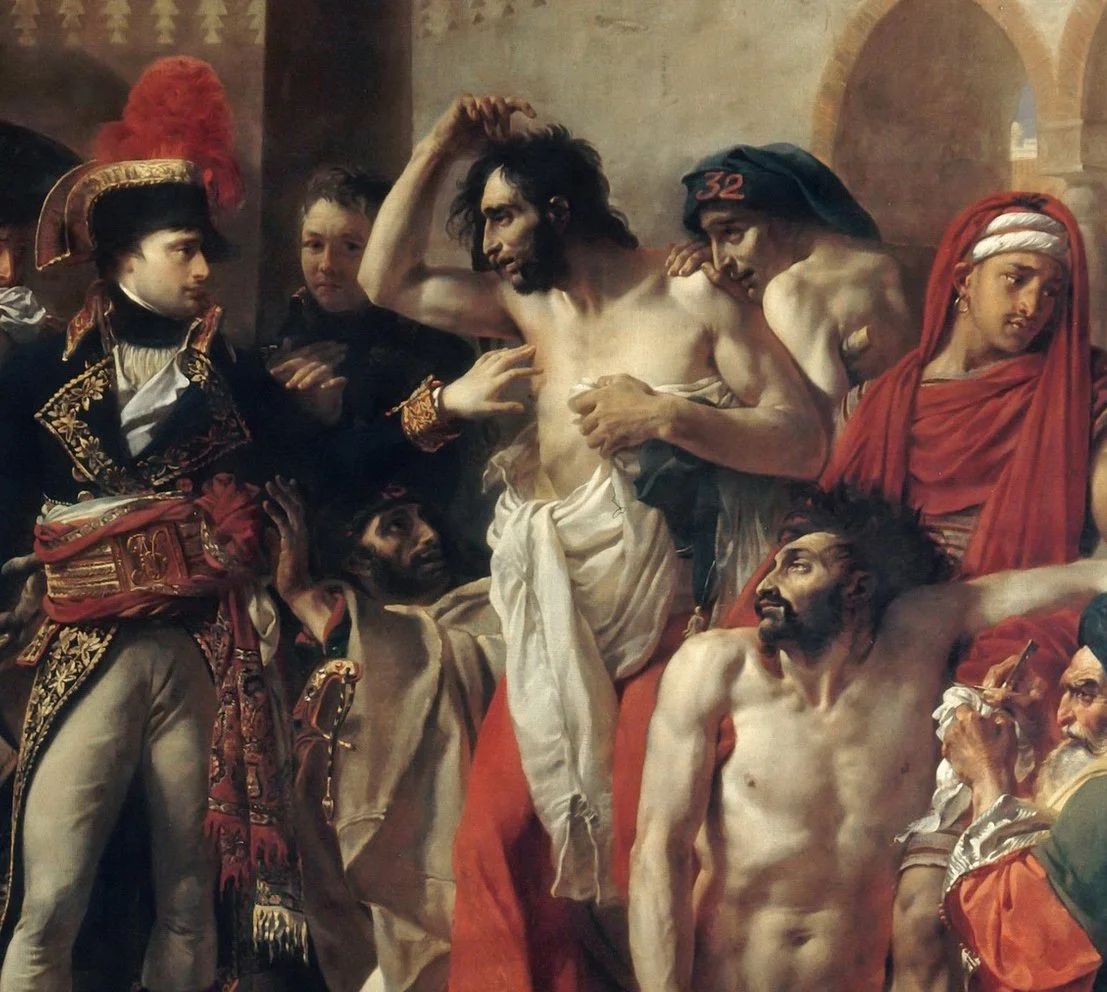
Detail: Bonaparte reaches out to touch the plague sore of a stricken soldier, as the soldier marked “32” looks on.
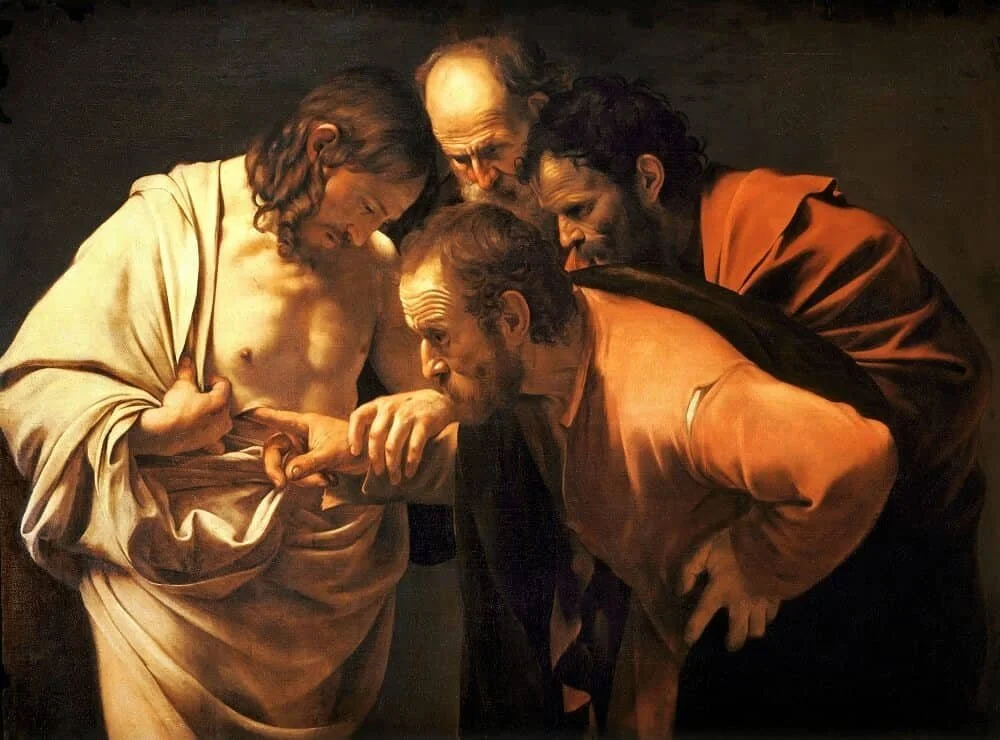
Caravaggio, The Incredulity of Saint Thomas, 1602. Oil on canvas. Sanssouci Picture Gallery, Potsdam.
Amidst the visceral reality of his contorted dying men, Napoléon fearlessly reaches out to touch the swollen infected buboes armpit of the naked French soldier, while another officer recoils in horror, his vain attempt to dissuade such peril falls unheeded, such Neoclassical drama, beautifully aligned with that of Caravaggio’s 1602 masterpiece, ‘The Incredulity of Saint Thomas’, its compositional mentor, aligning Napoléon with Jesus Christ and a fearless supreme divinity. Napoléon Bonaparte is God, and cannot be conquered by death, and as for you, the viewer, you are looking at a living deity an untouchable sacred leader of men whose presence alone had brought serenity and compassion to this moment of dismal human misery.
Gros painted this work when he was just thirty-two years old, much like the soldier whose hat boasts the same numeric emblem of time stitched into his draped headcloth, he can be seen peering over his comrades shoulder, an artist’s self-portrait perhaps or simply a comrade dying of scrofula whose imminent agonising departure is nothing more than a pathological affidavit of ‘Yersinia Pestis’, a miasma theory time stamp, where ignorance captured the flea infested causatum, its unbeknown calling-card of biological ruination and the embers of the second plague pandemic, more commonly known as, the Black Death.
Buried amidst pigment laden-hues, linseed oil and turpentine the truth however was theatrically mixed and diluted into what had become a palette of political theological mythology that advanced the idealisation of an enlightened ‘east’ a ‘mission civilisatrice,’ an aesthetic citation of Napoléon Bonaparte, the saviour who risked his life in the duty of others.
Beneath his masterful if not complicit brushstrokes, Gros chose to repel the reports of French atrocities, as while Jaffa burned, Napoleon’s troops plundered across the city ruthlessly slaughtering, Christians, Jews and Muslims indiscriminately and ordered the mass killing of three thousand ottoman prisoners held in French captivity. This was a spectacular counter narrative, which would likewise forgo Napoleon’s instructions to his chief medical officer Dr René-Nicolas Desgenettes to poison the remaining fifty or so dying soldiers, he refused stating; ‘My profession is to cure men, not to kill them’ . It would matter not, the men were ultimately administered a lethal dose of Laudanum by chief army pharmacist Claude Royer, and for the French public this was the ultimate betrayal of military honour. The painting was first exhibited on the 18th of September 1804 at the Academie des Beaux-Arts, between Napoleon proclamation on 18th May as emperor of France, and his ultimate coronation at Notre-Dame, Paris, on 2nd December of the same year.
This work by Antoine-Jean Gros is a magnificent, romanticised representation of a secular ruler blessed with a thaumaturgical royal touch, a divine inspirational calling that portrayed Christ healing of the lepers, having wrought miracles, it places Napoléon Bonaparte as the sacred bridge between God and all humanity, while arguably, it is nothing more than a conduit for imperialistic power, and where pestilence, immortality and a distorted reality ultimately collide.
It is not hard to imagine the stench of that courtyard, the human filth of decaying bodies beset with the plague. This was no temple of classical grief, but a sun-baked slaughterhouse choking on the sweet, heavy stench of liquefied lungs and bursting buboes while soldiers coughed up remnants of their own decomposing lungs onto the cold monastery stone, and beneath those elegant arches, lay a crawling carpet of human waste, where the living and the dead fused into a single grotesque mass. Let ‘us’ pause for a moment, is this really a history painting? Or is this actually something else, something so terrifying it can only be understood within the current socio-cultural malaise. Everybody knows the ‘plague is coming’, everybody knows the plague is here, fear not the man who calls it out, for he has understood the ‘stench of the courtyard’ and he alone, can see the wave of pestilence, running through the cobbles of every European decaying city.
Antoine-Jean Gros, Bonaparte Visiting the Plague Victims of Jaffa, was a piece of political propaganda, it had served its purpose and now has one final desperate act; This canvas, this ‘history’ painting, carries a veiled decree for the future: a warning that when the true contagion arrives, it guarantees that once the plague of institutional decay walks amongst us, your culture, your history, and your grace will be utterly erased. As for those ‘elites’ that facilitated such a demise, they will be found cowering in the filth and excrement of their own cowardice.
JamesWritten by James Darcy · galleriedesart.com · © 2026