
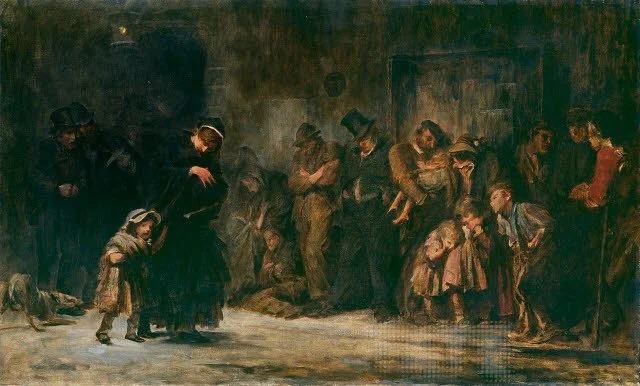
Luke Fildes, ‘Applicants for Admission to a Casual Ward’ (1874)
The prerequisite understanding for this work emulates in its portrayal of conditions endured by the destitute and how those in such gruesome circumstance were often ‘seen’ if not understood through a single motif; ‘queuing’, and how this iconographic language defined what was arguably a systemic institutional failure. Through this image which embodies the guttural filth spilling out from London’s Spitalfields, Whitechapel, Bethnal Green, and the ‘utterly uninhabitable’ misery of Mile End Old Town and Stepney. For context, a century earlier, Jean-Jacques Rousseau (1712-1778) wrote in, The Social Contract, ‘man is born free, and everywhere he is in chains’, such sentiment is now echoed here and woven within this visual language. Released from our historic abstruse monarchical influence our individual opinions, can by default, affect the prevailing opinion publique and so doing contribute to an interminable dialogue that encapsulates our moral gaze, while acquiescently observing a pietism so often portrayed when depicting societies destitute servile and impotent underbelly.
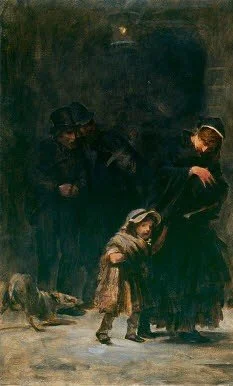
Detail: a ‘crawler’ woman, seen holding someone else’s baby and child walks the streets
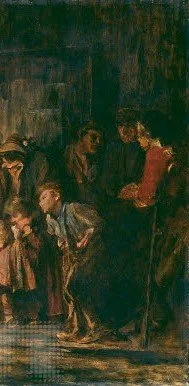
Detail: A wounded soldier, his bright red tunic the only primary colour Fildes utilised.
What is interesting, is the absence of any moral asylum, no longer could the state harbour or conceal urban reality, private man had now long developed as arbiter, a third-party bourgeoisie public sphere, this material ‘reasoning public’ with legitimate autonomous influence, that would, and did, exercise vehement societal opinion. Here in Luke Fildes, ‘Applicants for Admission to a Casual Ward’, he uses the motif of queuing to address the plight of the impoverished. Outside the police station they wait for a temporary workhouse ticket, the means by which to secure a bed, this one night only alms, hopelessly inadequate, and yet equally capable of stirring much public disagreement from those who would later view this visual reenactment.
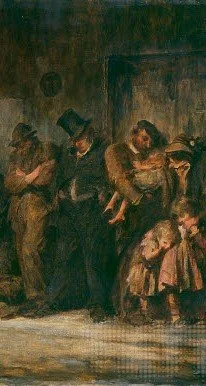
Detail: a drunkard, clings to the last remnants of dignity, his top hat, teetering on his head, like him, they are both too close to the ‘edge’.
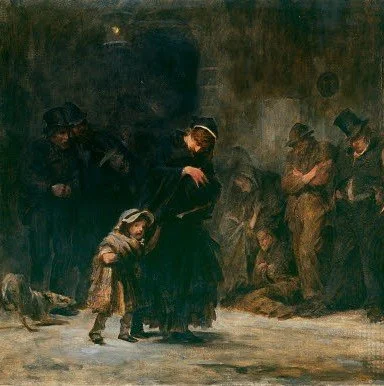
Detail: A harsh reminder ‘there but for the grace of God go I’
When first exhibited at the Royal Academy in 1874, the painting, while deeply popular, clearly touched a nerve. This troublesome landscape of human dishevelment, while lauded for its sincerity, simultaneously questioned public morality and in so doing, summoned forth an uncomfortable aura which was inherent within this melancholic portrayal of Victorian adversity. The exposure of such civic abdication created much public debate pitting a juxtaposition of lone responsibility with collective moral virtues often seen as an act of Christian benevolence.
What is interesting, this work enjoys the cultural grandeur in scale and execution of an academic history painting, a genre which had occupied the most pre-eminent artistic status. And yet, contemporaneously depicted a social moral pauperism the likes of which destroyed fragile lives in their thousands reducing the average age at death for a factory worker’s family to little more than fifteen years, while the mortality rates for a working-class child would see more than half dead before reaching the age of five. How then does the symbolism work in terms of such a cultivated aesthetic depiction and does this ‘idealisation’ of poverty furnish a useful representative vein, simply because queuing has been employed. It could be argued, that much like the portrayal of ‘bread’ during the French Ancien régime, the act of queuing as seen through a Marxist prism was in reality nothing more than economic violence and control against the working class, Karl Marx said; ‘the proletarians had nothing to lose but their chains,’ and this image, in and of itself, aligns queuing and its emblematic abandonment of self-worth.
It is clear the motif of queuing has been consistently used to epitomise poverty in artwork, and while the approach may differ in intensity the iconographic communiqué remains consistent. As with all motifs, the underlying efficacy can and will be governed by the collective imagery and aesthetics of which many factors are employed, not least the predominant style, but ultimately, it is the interpretation of meaning, and how that truly resonates with the viewer, be it through a moral conscience, or the absence of same that determine its intellectual weight, it is a kinetic movement that, in the end, must solely rest with the individual. On reflection, there is a fascination with the queue motif as both an instrument of hierarchy, a psychological aphorism and ultimately an artistic affirmation intentional or otherwise, to what was a systemic societal failure. It was undoubtedly understood as a moral dilemma during a period of ruthless industrialised capitalism which had scant regard for any sentimentality or indeed the poison of socialism.
When viewing the painting by Luke Fildes, ‘Applicants for Admission to a Casual Ward’ (1874) the first reaction might well be instigated by scale. An oil on canvas with dimensions of 137.1cm x 243.7cm it exhibits an imposing presence and yet has a dignified air of grandeur. Notwithstanding such poise, this is a bleak dire social narrative, bereft of flamboyance, in fact bereft of anything remotely uplifting. Instead, this muted landscape of misery facilitates, if not encourages the eye to examine a gathering of desolate souls who unobtrusively occupy the entire middle ground. This composition has been subtly cropped and raises doubt as to who stands beyond the picture space or is embroiled in this misery.
Outside the police station the destitute queue, their hopes for a workhouse refuge bed, a one-night pass to a temporary respite is the extent of any such benevolence they could expect, and much like their ubiety, the colour palette of brown blackish dirge offers little hope of expectation, a tonal emancipation that has established an atmosphere the destitute would understand. In this bitter winter’s night in London’s rancid squalor, a lone gas lamp burns, a metaphor of hope perhaps, its utility much like any faded anticipation is difficult to see. An indistinguishable background offers nothing more than a roughly applied impressionistic smudge with little to no regard for detail, its darkened archway for example, defined solely by traces of blockwork and mortar together with pictorial imagination. Against this dreary wall they come to rest, a social stanchion to lean against, its understated hierarchy being told through the policeman and ‘gentleman’, as seen discussing the disarray laid bare before them. Interestingly, the iconography reaffirms the stark realisation that such poverty does not discriminate, seen here the young and old huddle together, a drunkard, clings to the last remnants of dignity, his top hat, teetering on his head, like him, they are both too close to the ‘edge’. To his right, a man folds his arms fending off the cold, while a father holds a child, their bare legs and feet a metaphor of poverty dangle like an emblem of shame. A mother wipes away a tear, a comforting hand resting on her daughter’s shoulder, a harsh reminder ‘there but for the grace of God go I’. There are no alms beyond benefaction, a ‘crawler’ woman, seen holding someone else’s baby and child walks the streets, meanwhile a wounded soldier, his bright red tunic the only primary colour utilised, adding a striking compositional contrast and balance, if not a beguiling impression of movement as he leans on his crutch lost in conversation.
However you view this work, however ‘comfortable’ your life may be, it is impossible to separate the psychological melancholia which is clearly evident. It will seep beyond the picture space and it will taint you, because like them, the stench of life is now indistinguishable, you have joined the ‘queue’, and are unintentionally bound by the social stigma that a Poor Law has consistently failed to address, you are no longer a voyeur, you coalesce amidst this misery, and your ‘act of waiting’ acknowledges and records by virtue of this single ‘motif’, humanity’s, and by default, your own fall from grace.
Written by James Darcy · galleriedesart.com · © 2026
James Darcy